Language
Language
Metal-free porcelain teeth are increasingly being used to replace metal porcelain because of their aesthetic superiority as well as advanced technology in manufacturing and high biocompatibility, especially in aesthetic ceramic crowns. However, to this day, non-metallic porcelain still has the disadvantage of being less able to withstand chewing forces than metal ceramics. To overcome this drawback, the technical criteria for tooth preparation for metal-free porcelain teeth must be performed accurately, the tooth preparation must be ground to a sufficient level for each specific type of metal-free porcelain. Currently, there are two types of metal-free porcelain teeth that are widely used: Lithium Disilicate glass ceramic (emax aesthetic porcelain teeth) and Zirconia metal-free ceramic teeth. This article will present in detail the tooth preparation technique for Zirconia metal-free porcelain teeth, which is the most commonly used type of ceramic today.
Zirconia porcelain teeth are 2-layer metal-free porcelain teeth, the inner layer is a Zirconia ceramic rib that acts as a load-bearing frame, and at the same time is a layer that blocks the color of the tooth base, preventing the color of the real tooth from shining through the ceramic layer. The outer layer is a ceramic layer that creates color for the porcelain crown. Depending on the zirconia frame of different brands, this colored ceramic layer will be different. To ensure the stability of the porcelain crown when attached to the mouth, the tooth preparation technique for zirconia porcelain teeth needs to meet the following technical criteria:
– The finished line is a shoulder or deep curve, with a required thickness of 1 - 1.2mm.
– The surface of the shoe that needs grinding at the body and groove is 1.2 - 1.5mm
– The surface of the shoe that needs grinding at the biting edge or bearing area is 2mm

Preparatory tools for tooth preparation for metal-free porcelain teeth.
Required drill bits
– The diamond cylindrical bit has a flat and round tip, medium grit for grinding and fine grit for finishing
– Big round nose, lotus bud nose, wheel nose
– If you have an enamel chisel or an ultrasonic finishing line polishing tool after grinding the tooth, even better.

>>> If you are in need of dental implants but are unclear about the cost, let's find out in the article "How much does dental implant cost?".
The purpose of grinding the tooth base is to create a sufficient thickness for both the zirconia porcelain rib and the outer porcelain layer. The thickness must be uniform, not thick or thin, and the transition point of the finished lines must be smooth and soft, without sudden changes in direction or corners to create stress on the porcelain crown after installation, causing breakage of the porcelain crown.
Tooth base grinding for metal-free porcelain teeth is done through the following 5 steps:
Use a cylindrical drill bit with a diameter of 1mm to grind 3 lines, then grind the 3 lines together so that the drill smell is completely filled, the finished line is about 1mm above the gums.
 |
 |
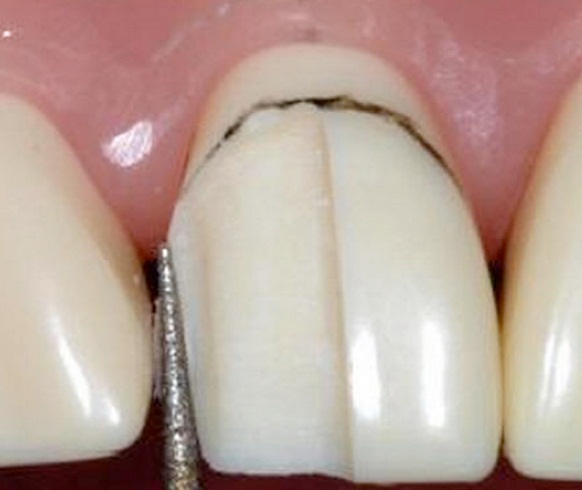 |
Use a cylindrical drill to shorten the biting edge 1.8mm compared to the adjacent teeth.

Use a tapered cylindrical bit (torpedo bit) to grind the side, be careful not to grind on the adjacent teeth. In difficult-to-control cases, steel sheets can be used to isolate adjacent teeth
Use a round tip cylindrical tip with a diameter of 1mm to mark the inside surface, then use a large clear tip or lotus bud tip to grind out the marking lines.

Depending on the type of finishing line selected, whether it is a curved edge or a shoulder edge, choose a cylindrical drill bit with a flat or round head to grind, place the thread to tighten and lower the finishing line to the contact above the thread.

Strict implementation of the above steps combined with accurate marking will create zirconia metal-free ceramic crowns with maximum aesthetics and durability. When you understand clearly What is a dental implant? Please choose a reputable unit to do it!
Lac Viet Intech Dental Clinic, a center specializing in implants, cosmetic porcelain teeth and braces.
Dong Da Headquarters: Building 160 Tay Son, Dong Da, Hanoi
Phone: 0971066726.
Cau Giay Headquarters: No. 9 Nguyen Van Huyen, Cau Giay, Hanoi
Phone number: 0971066726.
Hai Ba Trung Headquarters: No. 426 Minh Khai, Hai Ba Trung, Hanoi
Phone: 0971066726.
News on the same topic
Related questions
Featured news
Sign up for consultation
Partner of Lac Viet Intech Dental Clinic