Language
Language
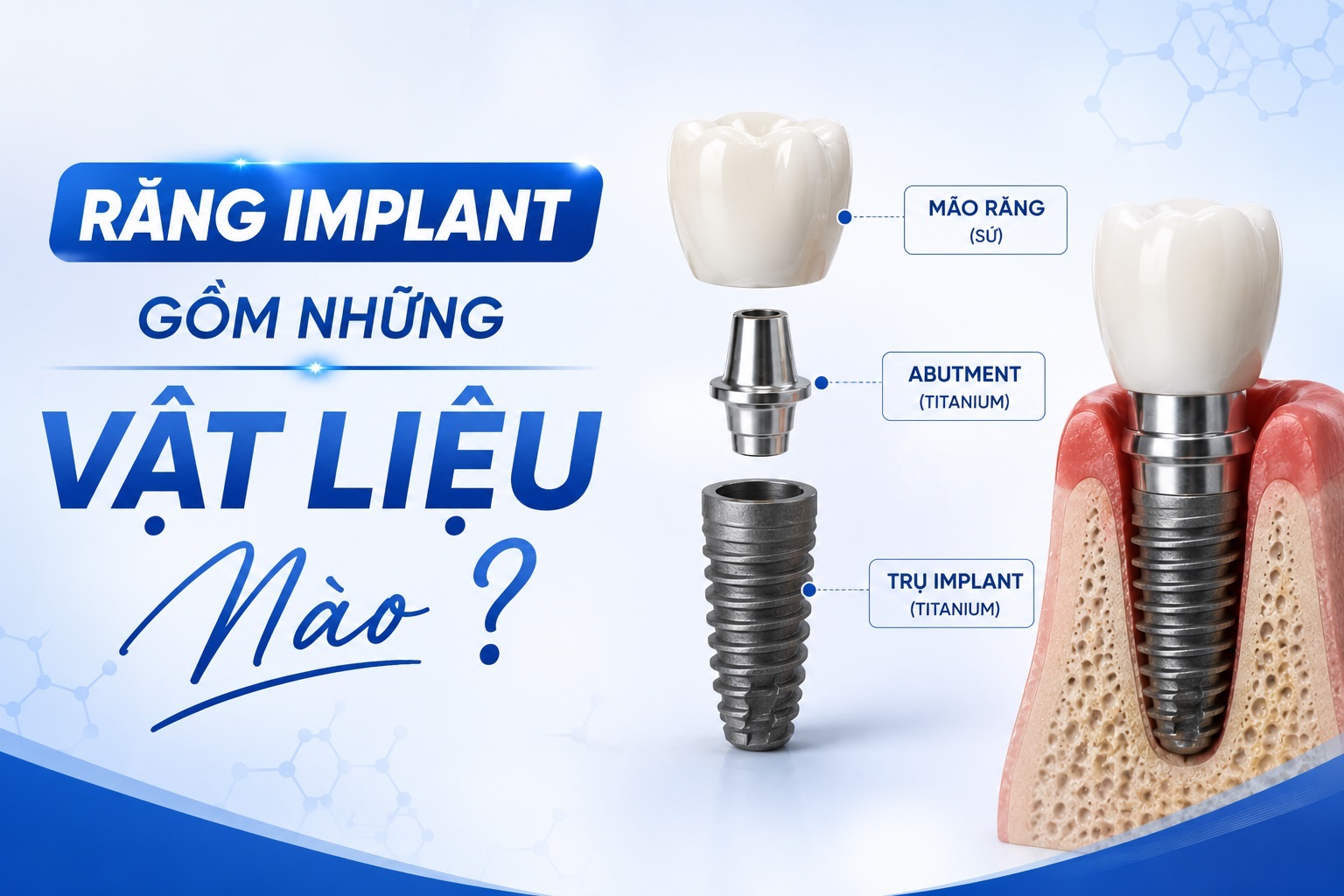
Regarding the role, each part of the dental implant will take on different and equally important roles. If just one of the above three parts is not good, the chewing function, aesthetics and longevity of the dental implant will be affected.

An ideal dental implant includes: Multi-layer full zirconia ceramic tooth, personalized zirconia anatomical restoration, SLActive surface implant or biofouling
Prosthodontic abutment, a specialized term called Abutment, is the part located between the porcelain tooth and the artificial tooth root.
In terms of structure, the restoration abutment consists of 2 parts: one part is located in the gums called the restoration abutment pedestal, this part is located deep in the gums, starting from the implant neck to the gum margin. A part protruding from the gums, where the porcelain tooth attaches, is called the connecting abutment.

The restoration abutment consists of 2 parts: the part located in the gums, which plays the role of shaping and biologically reestablishing the gums. The part that protrudes from the gums is called the connecting post, used to attach porcelain teeth.
The restoration post is considered the most important component in restoring aesthetics and food sensing for dental implants. It has the following 4 important roles:
The part in the gums of the restoration abutment plays a role in establishing the shape of the gums of the dental implant, and it also determines the natural color of the gums, as well as the natural color of the attached porcelain teeth. The prosthetic abutment is the most important factor that determines the aesthetics of a dental implant.

Images of commercially available prosthetic abutments and personalized surgery using zirconia.
The part in the gums of the prosthetic abutment has the role of direct adhesion to the gum tissue, aiming to create a biological barrier (called biological space) to prevent bacteria, food, saliva, etc. from the oral environment from penetrating the implant root below, thereby ensuring the safety of the implant root.

When choosing a good prosthetic abutment, it will bond with the gums into a unified block, creating a unified mass. Biological barrier protects the underlying implant.
The gingival part of the prosthetic abutment connects directly to the gum tissue by adhesion or epithelial adhesion, thereby transmitting chewing sensations, partly sensing taste and food pressure on the gum tissue. The prosthetic abutment is the only part of the dental implant that participates in/has the role of sensing and sensing food.
The prosthetic abutment is the connection between the implant root in the bone and the porcelain tooth in the oral cavity. When the dental implant performs the function of chewing and crushing, the chewing force from the porcelain tooth is transmitted through the prosthetic abutment through the implant tooth root, then absorbed and dispersed into the bone fibers (havers) in the jawbone.
A prosthetic abutment is called ideal, when it meets all 5 criteria. later:
Based on the above 5 criteria, abutments are divided into generations with the following 4 types (within the scope of this article, we do not mention low-quality low-cost restorations such as Stock Tungsten Abutments, Screw Co - Cr Abutments).
In addition, each type of Implant will have a different price, if you are interested. If you are learning about this issue, you can immediately read the article "how much does an implant cost" for more details.

Prosthodontic abutments include 4 generations with different qualities and prices.
>>> See more:The ideal criteria of a prosthetic abutment.
These are mass-produced prosthetic abutments, following a certain shape, which is circular in cross-sectional area and certain dimensions. This generation includes 2 types: cemented prosthetic abutment (Due Abutment or Stock Abutment) and screwed prosthetic abutment (Screw Abutment or Multi Unit).
Cemented prosthetic abutment (Stock Abutment).
Stock Abutment is a classic type of prosthetic abutment, born with the advent of implant abutment. Due to cost reasons, cemented prosthetic abutment is still being applied in some countries to this day.
Stock Abutment has only one shape, round, depending on the implant brand, the diameter and height are different, ranging from 4.5mm in diameter to 6.5mm in diameter. glass. 5mm to 7mm height. Cemented restorations are made from titanium using molten sintering and molding technology.

Abutment Stock is the classic type of prosthetic abutment with the cheapest price.
In terms of connection to porcelain teeth, Stock Abutment is bonded to porcelain teeth with an inorganic cementing substance such as Glasionomer or Fritex.
Because it has a unique shape, only a limited diameter and height, is crafted using molten sintering technology and is bonded to porcelain teeth with inorganic cement, cemented prosthetic abutments are a type of prosthetic abutment with many disadvantages. Points:

The tooth socket and gums around the tooth are not round, but are trapezoidal, parallelogram or ovoid shaped.

Image of a real tooth pulp (stem), it has a trapezoidal shape like a standard gum hole. This way we can create aesthetic benefits and avoid trapping food.

Pre-made screw or cemented restorations only have one round shape, so they are not capable of creating aesthetic benefits.
Because of many disadvantages, cemented restorations are less and less used, the only reason why doctors choose this type is because the price of this type is very cheap. However, from a professional perspective, cemented prosthetic abutments are only used to make temporary teeth, while waiting for the final restoration.
Screw Abutment.
Screw Abutment is a 2nd generation prosthetic abutment, created to overcome some of the disadvantages of Stock Abutment.
Screw Abutment is also a pre-made prosthetic abutment with the same technology as Stock Abutment, with only one The only shape is round, however this type has a smaller diameter (only 2 types are 4.5mm and 5.5mm) and is also less in size.
The only difference between Screw Abutment and Stock Abutment is that the porcelain tooth is connected on the Screw Abutment with a screw, so there is no need to use cement to attach, avoiding cement residue, protecting the biological barrier. On the other hand, the porcelain tooth is connected by screw, so it can be removed and repaired if there is a problem. However, it still has the following disadvantages.
In fact, Screw Abutment is only used in cases of complete tooth loss, are cases where gingival shaping is not required, because the Hybrid function is used.
This is the latest generation of prosthetic abutments, born thanks to improvements in material processing technology, CAD/CAM production technology, and especially Oral Scanning technology.
The birth of Customized Abutment is a big step forward for the dental implant industry, in particular, Customized Zirconia Abutment is considered the final connection point. Finally, bring dental implants to perfection.
Unlike the pre-manufactured prosthetic abutment generation, Customized Abutments are manufactured precisely for each patient and each tooth, with the desire to create a "tooth crown" that has the same shape as a real tooth crown, thereby re-establishing the ideal gum anatomy.
After the implant has been implanted in the jawbone, the doctor uses Scanning technology to copy the patient's teeth and gums, then transfers all this data to the prosthetic abutment production center. Here, doctors will design and produce a restoration abutment that resembles a real tooth crown, following the anatomical shape of the ideal gum cavity.
Based on the manufacturing material, Customized Abutment is divided into 2 types: Customized Abutment Titanium and Customized Abutment Zirconia.

Customized Abutment is divided into 2 types.
Customized Abutment Titanium: Personalized anatomical restoration with titanium.
Manufactured from titanium using CAD/CAM technology, Customized Abutment Titanium has most of the properties of an ideal prosthetic abutment including:
It has only one drawback, which is the black color of titanium, so in cases of thin gums, it can cause blackening of the gum line, affecting aesthetics.
Customized Abutment Zirconia: Personalized anatomical restoration with zirconia.
Customized Abutment Zirconia is considered the final connection point, bringing dental implants to perfection. Instead of being made of titanium, it is made of Zirconia to overcome the final drawback of Customized Abutment Titanium, which is darkening of the gum line. Because it is made from Zirconia, white in color, Customized Zirconia Abutment does not darken the gum line like Customized Titanium Abutment.
An absolute advantage of Customized Zirconia Abutment is the ability to create a biological barrier. Customized Zirconia Abutment has the ability to biologically connect with gum tissue by an epithelial bond, an extremely solid bond (similar to bonding the gums to the jawbone), capable of absolutely preventing the penetration of bacteria from the oral environment to the implant base below.
Customized Zirconia Abutment has only one drawback: its high price.
>>> See details about personalized anatomical prosthetic abutments in the article:These Things to know about personalized anatomical restorations.

Personalized anatomical restorations made of Zirconia have the same shape and color as the tooth crown.
In summary: The ultimate goal of dental implants is for chewing and aesthetic purposes, to the end of the purpose, the prosthetic abutment can be considered the most important component of a dental implant. If the restoration abutment is not chosen well, even if the implant base is solid, it still cannot give you a beautiful dental implant that allows you to chew without choking on food and without chronic infection. Therefore, choosing a good restoration is an extremely important factor when you choose dental implants.
News on the same topic
Related questions
Featured news

Sign up for consultation
Partner of Lac Viet Intech Dental Clinic